


PRODUCT PLATFORMS / 04
Choose a connection
that fits the equipment.
From compact signal interfaces to power distribution, panel receptacles and branched harnesses: start with installation, service access and operating conditions, then choose a family and part number.
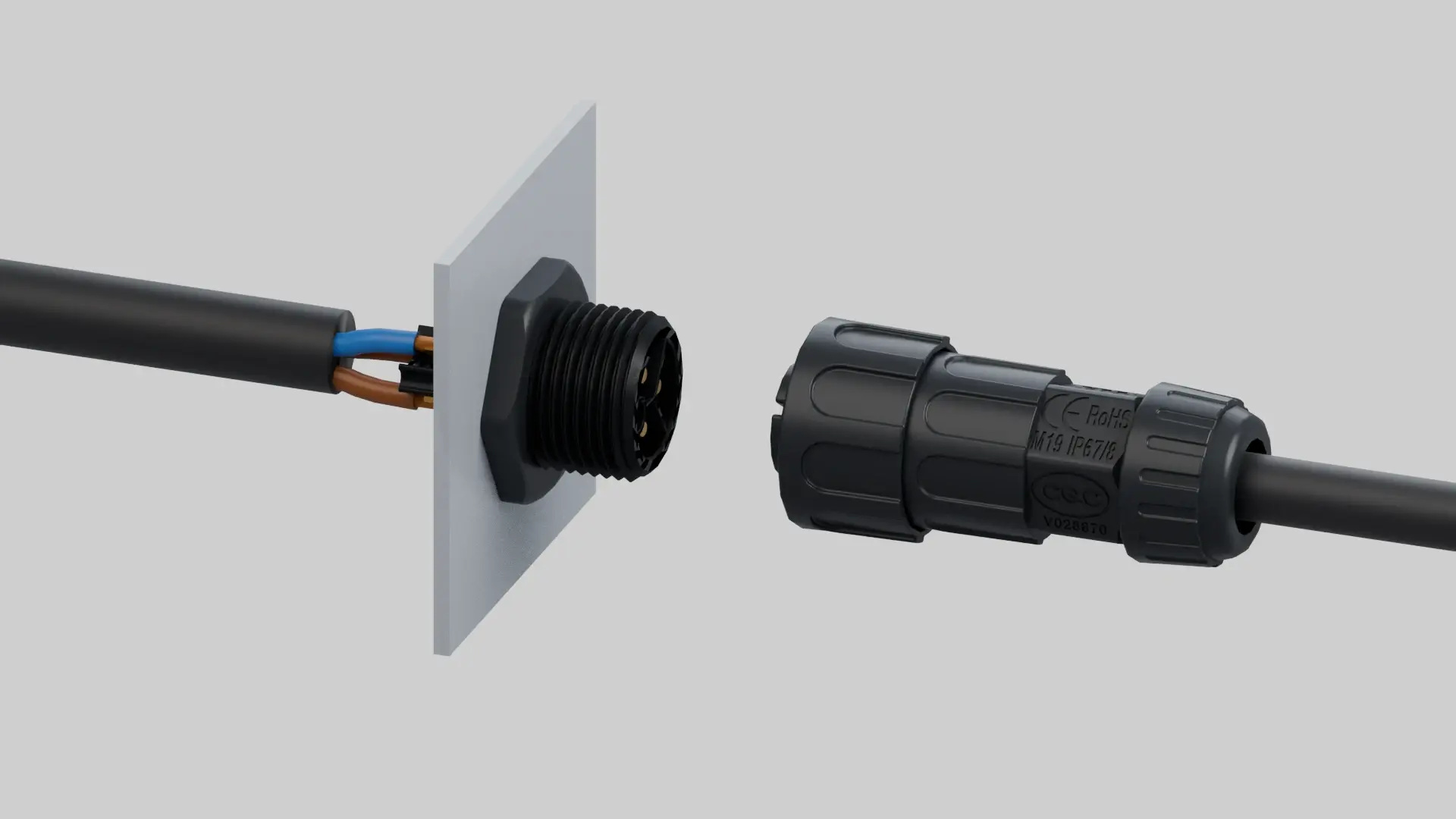
Select the connection architecture before comparing ratings.
Company product material covers threaded, quick-bayonet and self-locking couplings, with inline, front-panel, rear-panel and flange arrangements. A family name is a starting point: one size family may contain several mounting and termination options. Current, contact count and cable range must be checked for the actual part number.
Compact interfaces
M8 and other compact interfaces bring panel space, pin assignments and rear sealing into the selection discussion.
Circular power connections
M25 and M29 families can be explored by mounting, coupling and electrical configuration. Photovoltaic variants need their own application and certification review.
Branches and distribution
T- and X-shaped distribution units put trunk wiring, branches, terminal space and service access on the same installation plan.
Custom cable assemblies
Specify length, conductor size, branch positions, end interfaces and finishing together, before installation constraints become a late-stage problem.
See the structure and the operation.
These three mechanism animations come from the company presentation. Observe insertion, rotation or self-locking, then consider access in your installation: can the coupling be gripped, is a tool required, and could operation twist the cable? The animations explain mechanisms; ratings remain drawing-specific.
Threaded: front-panel arrangement
M19 demonstration: observe access to the threaded coupling after alignment and insertion.
Self-locking: inline connection
M29 screw-termination demonstration showing mating retention and rear-component relationships.
Quick bayonet: align, insert, rotate
Solder-version demonstration showing circumferential guidance and the locking action.
Animation source: October 2026 company presentation, slides 8–10.
Connect the catalogue to the application.
M25 circular connectors
Review contact counts, mounting options and cable-end combinations.
M29 photovoltaic family
Check electrical configuration, coupling and scope against the target system.
L16 distribution
Start with circuit count, branch directions and termination space.
LPEV interfaces
Review part-specific termination configurations for the power connection.
Give engineering a defined starting point.
With equipment photographs or an installation sketch, mark the connection location, panel thickness, access space and cable direction. Add per-contact operating current, maximum working voltage, cable diameter and environmental conditions. These inputs help the team choose between a standard part, a revision and a custom assembly, then document the agreed sample in drawings and inspection requirements.
TALK TO ENGINEERING
Bring your application to the conversation.
An installation sketch, operating load, cable details and environmental conditions make a useful starting point.
Contact LLTSelect by parameters →